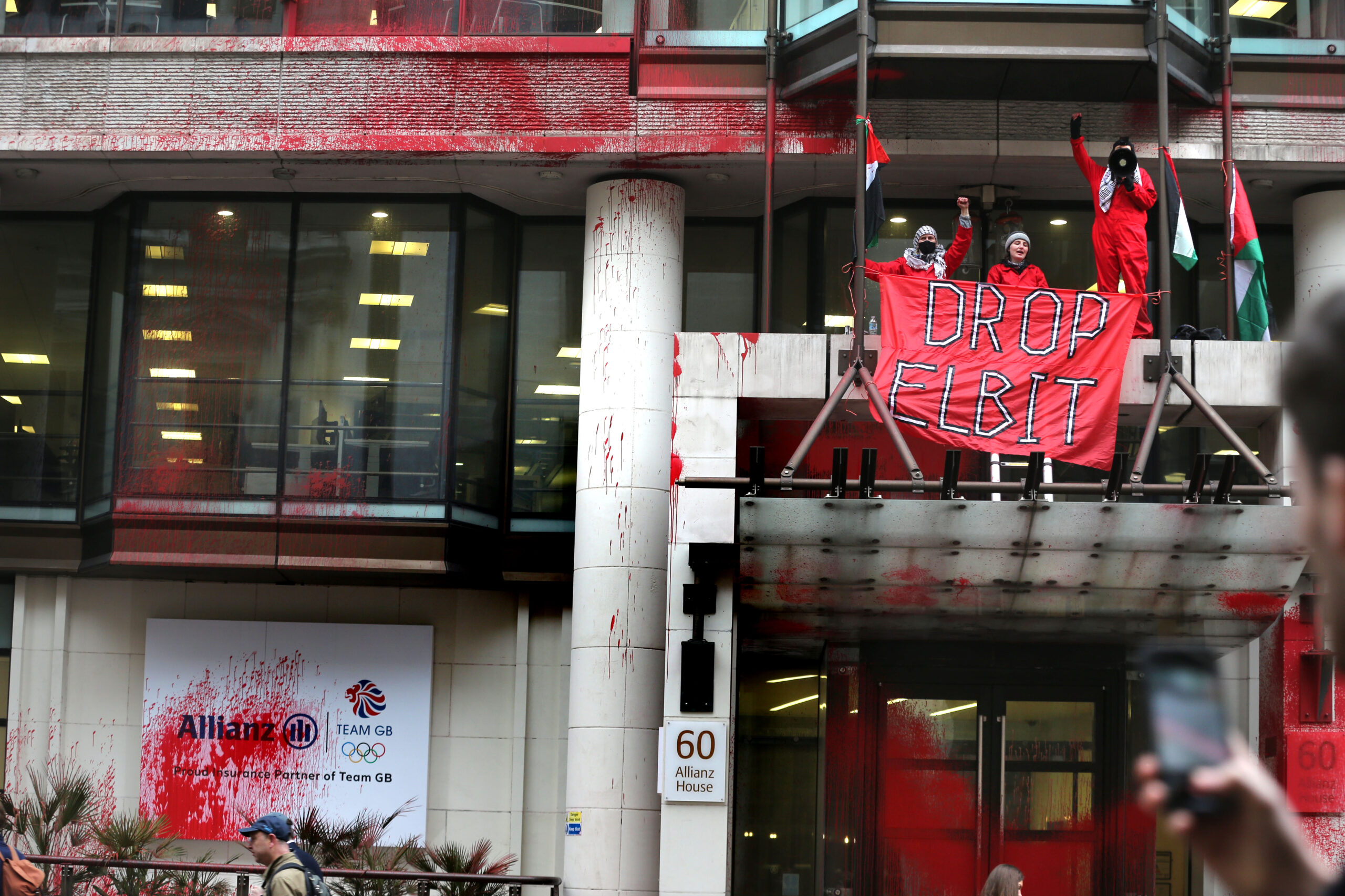
The time to swap your banner for a sledgehammer is here.
In his essay, Crosshairs, Palestinian writer Abdaljawad Omer describes the sniper that marks the Palestinian as a target. The Palestinian’s “very being” becomes “a canvas for the twisted delight of those who wound and slay.”
The sniper is the hunter, and the Palestinian is the prey. And we are also part of the hunt, because the Palestinians we claim to feel solidarity for are on the “receiving end of an entire machine that builds both the logic of rendering them targets and then aiming with relentless anger and joy.”
Empire’s entire system is built on the idealisation and advancement of fascistic militarism.
In his reflections on being wounded by the sniper’s bullet, Omer notes how “War, a visceral horror of flesh and blood, is now sanitized by the western war machine’s affinity for distance—a treasured void where death decrees are dispatched lacking the chaos of bodily entanglements”, asking us, “Isn’t this one of Israel’s most authentic roles in the “global order,” a place to experiment with new codes, regulation and codifications, a revisionist state that reformulates the entire architecture of rule-based Empire, empowering it with innovative practices and ways to transgress its own rule-making power?”
It is easy to claim you are not intimately involved, because you aren’t dressed in the uniform, and your hand isn’t operating the weapon. But the distance granted to the sniper begins here, in the Israeli weapons factories in Britain and global incubator states, supplying the hunter with an endless flow of weaponry so he can enjoy the exterminating supremacy of math and machine- as Omer observes, “The sniper’s first pleasure is the pleasure that distance allows.”
The solidarity movement in Britain has long been at an impasse. Politely circumventing the Zionist arms factories that are building the weapons to be tested in real time on our Palestinian brethren has faithfully been accompanied by flirting and pleading with the state running and profiting from that ludicrous war machine to stop the flow of weapons to the Zionist settler colony. To absolutely nobody’s shock decades on, this tried and tested method of protest has not worked.
The first direct action network for Palestine in Britain shattered this impasse. Founded in 2020, Palestine Action’s strategy was simple: to take sustained direct action against the Zionist war machine in Britain until it is dismantled – for good.
To do this, disruption, a willingness to sacrifice – risk arrest, remand, and imprisonment – and creating a dilemma in which the cost of investing in Israel’s largest weapons manufacturer, Elbit Systems, would outweigh the profits gained, was essential. This was not only possible, it irrefutably proved to be the most effective tactic by far in the struggle for Palestinian liberation, quickly becoming a global movement, and proving direct action is not exclusive: there is a role everyone can take on.
Unlike civil disobedience, direct action is not about revolting against an unjust law; it is seeking to overturn the entire system that made that law functional in the first place – targeting the source of the injustice directly. As Omer said, rule-based Empire “is precisely why we Palestinians never take international law seriously, or at least many of us don’t. We know what the rest of the world will grow to know: that these laws serve only the pleasure of the hunt.”
It is interesting then, that direct action was not immediately adopted by the solidarity movement in Britain en masse; but it is also unsurprising.
Only Direct Action gets the goods
Consider this. It took a globally cinematic genocide to wake the masses up to the colonisation and occupation of Palestine. And not because colonisation and occupation were seen as problematic in themselves, but because the violence of colonial maintenance in Gaza became too rabid for the so-called civilised world to stomach.
It was only after the proscription of Palestine Action that the actionists who put their bodies in the way of the Zionist war machine in Britain were even acknowledged as fellow activists in mainstream political spaces; when, as proscription turned into a looming reality, everyone “became” Palestine Action.
The existence and plight of the prisoners, locked up by the state on allegations of taking action against the source of the Gaza holocaust in Britain, only filtered into our awareness when eight of them began to starve themselves for justice, and to shut Elbit down. Have you noticed a pattern yet?
That the largest civil disobedience movement in recent history emerged in Britain after the proscription of the most successful and effective direct action movement for Palestine was proscribed, amidst the holocaust of our time, in outrage at the curtailing of our liberties, is a banal affirmation of the reality of protest in the system we function in: we do not organise, we react. And volatility isn’t just unsustainable, it is disorganisation at its best. It is skirting around the real source of our outrage, when we should be confronting it directly instead; and it is proclaiming support for a direct action movement whilst turning a wilfully blind eye to the strategy behind its success.
For the mainstream media who we abhor and criticise, for something to be considered newsworthy, it must be shocking to the senses, unusual, new, and timely.
But we function no differently. Our reaction to terrible events fluctuates, sinks and resurfaces as the shock wears off and is replaced by something newly alarming. Like fireworks, our energy comes in bursts, our attention held only for as long as our mind understands an event to be an emergency that requires us to escalate. We are running on a time limit, and when we arrive at what we have predetermined are the final moments, wherein we come to terms with the false belief nothing more and nothing else can be done, the need to escalate slowly disappears into the deep recess of our memories. Then the agitation, the uncomfortable disbelief, soon becomes part of our collective amnesia.
Britain’s colonisation and its murdering militias are a very distant memory, but so are the babies in incubators left to die, and the flour massacres and the tent massacres and the Rafah invasion and the non-stop bombing and decimation of every inch of Gaza. The 10,000 or more Palestinians locked in horror dungeons and raped and tortured by specialist doctors and soldiers have disappeared from our current memories too.
Our collective memory should begin with the original architect of the colonisation of Palestine and its Zionist representation on British soil. This is very easy to remember, and well within our reach. Never forget, there are many perpetrators, but only one source.
The state’s concept of victory is your predictable pattern of behaviour, your well-dependable mode of protest that has learned to absorb shock after shock, your outraged reaction confined to a predictable timeframe the state can manage the consequences of. A momentary glitch, a tear, in the system that even you can hardly believe was possible, is quickly repaired, brushed over, and covered with another protective layer of suppressive law. As Amerikan political prisoner Christopher Naeem Trotter noted, “From my understanding, the stages of violence [are] oppression breeds resistance, and resistance brings repression.” And as political prisoner Casey Goonan said, repression has prevailed “each time the solidarity movement came upon the choice of resistance and chose safety, legitimacy, and stability instead of struggle…”.
Two years into the first cinematised holocaust the world had witnessed and mass protest was absurdly confined to marching up and down the streets in London, Britain’s face of civilisation, complete with police entourage. The demonstrations made history – for their numbers, not their impact, because although they provoked the state’s ire, they were manageable on the ground and after more than two years of uninterrupted unhinged violence, essentially incapable of immediately affecting the political landscape.
Compare this to an untenable direct action campaign, which the state could not and cannot sustain, because it is simply outside the realm of its control. You do not ask for permission to break into a Zionist weapons factory to damage and dismantle the drones breeding colonial violence. You do not ask for permission when you smash and spray paint your chosen target in the Zionist supply chain, costing it thousands, if not millions in damages. You certainly do not ask for permission when you shut it down using your own body, be it temporarily or permanently, like in Tamworth, in Oldham, in Bristol, and in Britain’s rabidly civilised capital.
And when anyone asks you why Merseyside Pension Fund, Scotiabank, Barclays, Edward Accountants, Aviva, and Allianz made the decision to divest from Elbit Systems, you only need to tell them direct action gets the goods.
Because unlike popular protest, direct action refuses to subscribe to the terms and conditions of a system that will allow mass protest so long as it does not threaten the financial arteries sustaining its existence.
How far can we go in our commitment to justice?
Consider another example of the state’s ability to manage its polity’s (temporary) reaction to injustice.
During the hunger strike, the British government was weighing the risks it could afford to take in continuing to refuse to negotiate with the hunger strikers and their representatives. The Ministry of Justice received health updates everyday; they knew one or more of the hunger strikers could go into cardiac arrest, could die, at any moment. The point is not that they did not care (they didn’t) but that this was a risk they believed they could manage.
This is why one of the non hunger striking prisoners noted how the hunger strike was a gamble, not on the government, but on our collective conscience. Because we, too, are weighing the risks. How far must we go – how far can we go – in our commitment to justice? Are we willing to go to the source – to cross the distance to the Zionist arms factory a few hours or minutes away from where we live and dismantle the drones inside, something our prisoners proved is possible? How close is too close when you are living in the vicinity of the colonial violence laundered through your witness box?
The hunger strikers were all accused of one thing or, of the highest compliment: taking direct action against an Elbit Systems factory in Bristol to successfully dismantle the killer drones and quadcopters inside, or against military planes in an RAF airbase in Brize Norton because the state was using the base in genocidal aid surveillance. And behind prison walls, as they undertook a collective hunger strike, they were concerned with one thing only: compelling those who mobilised in solidarity with them to make the connection between the Zionist arms factories operating under our noses and the only way they could be shut down. As T. Hoxha said in a statement at the end of the hunger strike: “We [are] victorious in the knowledge that people have been moved to take direct action, taking upon themselves the very idea we stand accused of.”
Just as the hunger strikers worried about the sigh of relief that accompanied the announcement of a pretend ceasefire in holocaust, and the proscription of Palestine Action resulted in a mass civil disobedience campaign meticulously carried out with placards and marker pens (with the conscious choice these were not – in any circumstances- to be accompanied by sledgehammers, crowbars, and spray paint), history teaches us repressive attacks and political fatigue are the moments in which the system reorganises, attempting to repair the tear as if it never existed. Every lull in the escalatory action of the solidarity movement is capitalised on by the state, ensuring a process of refeeding and recovery is taking place. But sustained direct action is different. It has the ability to inflict losses irrespective of the political climate or the state’s mode of warfare: even after the proscription of Palestine Action (which the High Court has now deemed unlawful), the commitment to taking direct action never stopped, and targets in the genocidal supply chain have remained under attack.
‘We are all on the frontline’
It makes no sense to ignore and abandon a tactic with a track record of success unmatched by any other when it has been proven it is the only thing that works, or to slow down; if anything, direct action demands and commits to the urgency of taking action – and accelerating this – until the purpose of Palestinian liberation is realised.
As the Palestinian intellectual warrior, martyr Basel Al A’raj said, we are all on the frontline.
Disproportionate action during emergencies is what creates precedents. That is why the role of the individual is so critical. Carrying out and manufacturing consent for an ongoing holocaust (after more than a century of colonisation and occupation) committed using the most lethal weapons in existence – that are built in weapons factories in your peaceful, law-abiding neighbourhoods – doesn’t happen overnight. It is a well-thought-out predesigned process, a calculation by the state of the speed with which we can absorb what we feel. One of the reasons why direct action is so powerful is the refusal to switch off, to normalise atrocities, and vitally, the refusal to withhold the power you know you have to go after the domestic source of the oppression.
When you understand direct action for what it is at its very essence: targeted and focused, stable and current, riding every shock and absorption, unmoved by the distractions and threats of the state because your mind and body are set on directly dismantling the Zionist genocidal supply chain domestically because you can, you will realise how fragile the system the state has built around us really is. Every target is within reach. Every target that is hit costs the Zionist war machine individually and collectively, is physically dismantling the global genocidal supply chain multiple targets at a time. With direct action, we have never been closer to Palestinian liberation.
As George Habash once said, “Imperialism has laid its body over the world… Wherever you strike it, you damage it, and you serve the World Revolution”.
Start where you are. The change we want has always been possible. It’s just a matter of how much we want it.
Take the first step by signing up to our direct action trainings: directactiontraining.org